Every day, thousands of Nigerian business owners click the bright blue “Boost Post” button on Facebook and Instagram, hoping to reach more customers. They spend ₦5,000, ₦10,000, or even ₦50,000, thinking they’re running a professional advertising campaign. But here’s the harsh truth: you’re probably wasting your money.
Facebook Ads & Google Campaigns
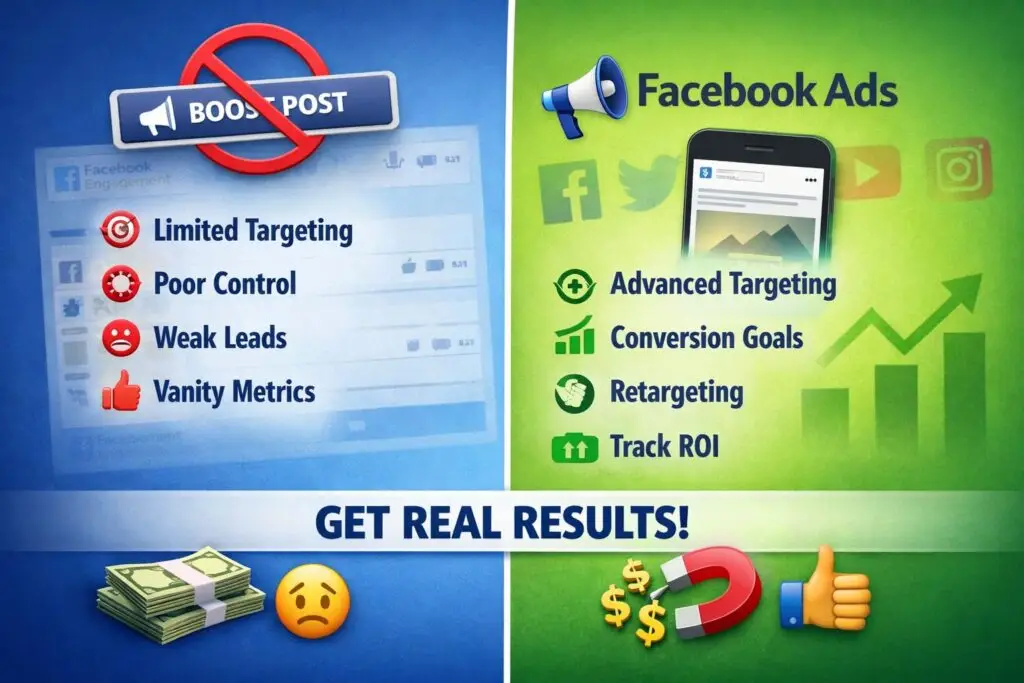
If you’re a business owner in Ibadan or anywhere in Nigeria who’s been boosting posts and wondering why you’re not seeing real results, this article will open your eyes to what you’ve been missing. More importantly, it will show you how to actually get a return on your advertising investment.
At Digital Flames NG, we’ve helped dozens of businesses in Ibadan transform their social media advertising from money pits into profit centers. We’ve seen firsthand the difference between clicking “Boost” and running strategic ad campaigns. The difference? Often 5-10 times better results for the same budget.
Let’s dive deep into why the Boost Post button is costing you money and what you should be doing instead.
What Exactly Is the “Boost Post” Button?
The Boost Post feature is Facebook’s (Meta’s) way of letting anyone advertise with just a few clicks. You create a regular post on your business page, and if you want more people to see it, you click “Boost Post,” choose your audience, set a budget, and boom – you’re advertising.
Sounds simple, right? That’s exactly the problem.
Facebook makes the Boost button incredibly accessible because it wants as many people as possible to spend money on ads, regardless of whether those ads actually work for the advertiser. It’s designed for ease, not effectiveness.
Think of it this way: the Boost button is like using a sledgehammer when you need a scalpel. Sure, it’s a tool, and it does something, but it’s not precise, strategic, or optimized for your actual business goals.
Why Nigerian Businesses Love the Boost Button (And Why They Shouldn’t)
Before we get into why boosting posts is problematic, let’s acknowledge why it’s so popular among Nigerian business owners:
It’s easy: No technical knowledge required. Even if you’ve never run an ad before, you can boost a post in under a minute.
It feels affordable: You can boost a post for as little as ₦1,000, making it accessible to businesses with small budgets.
It’s instant gratification: Within minutes of boosting, you start seeing likes, comments, and shares rolling in. It feels like it’s working.
It’s familiar: You’re just promoting a post you already created, not building something from scratch in an unfamiliar ads platform.
Read Also: 3 Reasons Why You Shouldn’t Delay Your CAC Registration in 2026
These benefits are real, but they’re surface-level. Underneath, there are serious problems that cost you money every single day.
The Hidden Problems with Boosting Posts
Problem 1: Limited Objective Options
When you boost a post, Facebook gives you just three basic objectives:
- Get more engagement (likes, comments, shares)
- Get more messages
- Get more website visits
Sounds fine, right? Wrong. Real Facebook Ads Manager offers over a dozen campaign objectives optimized for specific business goals:
- Brand awareness
- Reach
- Traffic
- Engagement
- App installs
- Video views
- Lead generation
- Messages
- Conversions
- Catalog sales
- Store traffic
Each objective uses different algorithms and optimization strategies. When you boost a post, Facebook’s algorithm optimizes for engagement by default, which often means your ad gets shown to people who like and comment on posts but never actually buy anything.
Real-world example: A clothing boutique in Ibadan boosted posts showing their new arrivals. They got hundreds of likes and comments like “Nice!” and “Beautiful!” but zero sales. Why? Because Facebook showed the ads to people who engage with posts, not people who actually shop online. When we switched them to a conversion campaign in Ads Manager, targeting people with a history of online purchases, their sales increased by 400% with the same budget.
Problem 2: You Can’t Control Ad Placement
When you boost a post, Facebook decides where your ad appears. It might show up in:
- Facebook News Feed
- Instagram Feed
- Facebook Stories
- Instagram Stories
- Facebook Right Column
- Audience Network (random apps and websites)
- Messenger
Here’s the problem: different placements perform very differently for different businesses. A video ad might work great in Stories but terribly in the right column. An e-commerce ad might convert well on Instagram but not on Messenger.
With boosted posts, you have zero control. Facebook chooses placements based on where it can show your ad cheapest, not where it will perform best for your business.
In Ads Manager, you can:
- Select specific placements
- Test different placements against each other
- Allocate more budget to placements that convert
- Exclude placements that don’t work
This level of control can easily double or triple your return on investment.
Problem 3: Primitive Audience Targeting
The audience targeting in Boost Post is like using a megaphone in a crowded market. Sure, you’ll reach people, but will you reach the right people?
When boosting, you get basic options:
- People who like your page
- People who like your page and their friends
- People you choose through targeting
The “people you choose through targeting” option gives you some demographics (age, gender, location) and interests, but it’s severely limited compared to Ads Manager.
What you’re missing with Boost Post:
Custom Audiences: Can’t target people who visited your website, people on your email list, people who engaged with your Instagram account, or people who watched your videos.
Lookalike Audiences: Can’t target people similar to your best customers. This is one of the most powerful targeting options available, and boosted posts don’t have access to it.
Detailed Demographics: Limited access to detailed targeting like household income, education level, job titles, life events, purchase behaviors, and device usage.
Boost vs. Campaigns: Which One Actually Grows Your Business Faster?
Exclusions: Can’t exclude people who already purchased, people you’ve already reached, or other audiences you want to avoid.
Layered Targeting: Can’t combine multiple targeting criteria with AND/OR logic for precision targeting.
Let’s look at a real scenario: You run a premium gym in Ibadan targeting young professionals. With Boost Post, you can target “people interested in fitness” aged 25-40 in Ibadan. Sounds okay, but you’re showing your ₦30,000/month gym membership to students, people already going to budget gyms, and people who have no money to spend.
With Ads Manager, you could target:
- People interested in fitness AND premium brands
- Who have household income in the top 25%
- Who work in corporate jobs
- Exclude people who like budget gym pages
- Create a lookalike audience of your current members
See the difference? One approach is guessing. The other is strategic.
Problem 4: No Conversion Tracking
This is perhaps the biggest problem with boosted posts. You can’t properly track what happens after someone clicks your ad.
Sure, Facebook will tell you:
- How many people saw your ad
- How many clicked
- How much you spent per click
But it won’t tell you:
- How many purchased
- How much revenue you generated
- Your return on ad spend
- Which specific products sold
- What your cost per lead or sale was
Without this data, you’re flying blind. You have no idea if your advertising is actually profitable.
With Ads Manager and the Facebook Pixel properly installed, you can track:
- Every purchase on your website
- The exact revenue from each campaign
- Cost per purchase
- Return on ad spend
- Cart abandonments
- Add to carts
- Leads generated
- Form submissions
- Phone calls (with call tracking)
This data is everything. It’s the difference between hoping your ads work and knowing they work.
Problem 5: You Can’t A/B Test Effectively
Marketing is all about testing. What image works best? What headline converts? What audience responds? What call-to-action drives sales?
With boosted posts, you can’t run proper split tests. You’re stuck with one version of your ad, shown to a broad audience, with limited data on what’s working and what’s not.
Ads Manager lets you:
- Test different images against each other
- Test different headlines
- Test different audiences
- Test different ad formats
- Test different placements
- Run dynamic creative tests where Facebook automatically tests combinations
These tests reveal insights that can transform your advertising. We’ve seen tests where simply changing the headline increased conversion rates by 200%. We’ve seen audience tests where one segment outperformed another by 500%.
Without testing, you’ll never find these opportunities. You’ll just keep boosting posts and hoping for the best.
Problem 6: Higher Costs, Lower Results
Here’s something Facebook won’t tell you: boosted posts often cost more per result than properly optimized campaigns in Ads Manager.
Why? Because:
- The algorithm isn’t optimized for your actual goal
- You’re showing ads to the wrong people
- You’re using inefficient placements
- You’re not leveraging advanced features that reduce costs
In our experience working with Ibadan businesses, switching from boosted posts to Ads Manager campaigns typically results in:
- 40-60% lower cost per click
- 3-5x better conversion rates
- 5-10x better return on ad spend
Same budget. Same products. Same business. Just better strategy and execution.
Problem 7: Limited Ad Formats
When you boost a post, you’re stuck with whatever format that post is in. A single image, a video, a carousel – whatever you originally posted.
Ads Manager gives you access to advanced formats that boost doesn’t:
- Collection ads (perfect for e-commerce)
- Instant Experience ads (full-screen mobile experiences)
- Lead generation ads with built-in forms
- Dynamic product ads that automatically show people products they viewed
- Messenger ads that start conversations
- Playable ads for games and apps
Many of these formats significantly outperform standard post formats, but you’ll never access them through the Boost button.
The Psychology of Why Boosting Feels Good (But Isn’t)
Let’s talk about why boosting posts feels so satisfying, even when it’s not effective.
Instant feedback: Within minutes of boosting, you see likes and comments rolling in. Your brain gets a dopamine hit. It feels like success.
Vanity metrics: Boosted posts excel at generating likes, comments, and shares. These feel good but rarely translate to business results. A thousand likes don’t pay your rent. Sales do.
Low barrier to entry: It’s so easy to boost that you feel productive. You’re “doing marketing” without the hard work of strategy, targeting, and optimization.
Confirmation bias: If you get any positive result (even just engagement), you convince yourself it’s working. You ignore the fact that you spent ₦20,000 and made zero sales.
This psychological trap keeps many Nigerian businesses stuck in a cycle of boosting posts, getting superficial results, and never building a real advertising system that drives revenue.
What You Should Be Doing Instead: Real Facebook Advertising
Now that we’ve thoroughly buried the Boost button, let’s talk about what effective Facebook and Instagram advertising actually looks like.
Step 1: Install and Configure Facebook Pixel
The Facebook Pixel is a piece of code you install on your website that tracks what visitors do. It’s the foundation of effective advertising.
Without the Pixel:
- You can’t track conversions
- You can’t retarget website visitors
- You can’t build lookalike audiences
- You can’t optimize for purchases
- You’re advertising blind
With the Pixel properly installed:
- Every action on your site is tracked
- You can retarget people who viewed products but didn’t buy
- You can create audiences of people who purchased
- Facebook’s algorithm can optimize to find more buyers
- You have data to prove ROI
Installing the Pixel requires technical knowledge. If you don’t have a developer, this is where agencies like Digital Flames NG come in. We install and configure Pixels for businesses all the time, ensuring every tracking event is properly set up.
Step 2: Define Clear Campaign Objectives
Before you spend a single Naira on ads, ask yourself: what is the specific goal of this campaign?
Not “get more customers.” That’s too vague.
Be specific:
- Generate 50 leads for our new service
- Sell 100 units of this specific product
- Get 500 people to download our app
- Drive 1,000 people to visit our physical store
- Build an email list of 200 potential customers
Your objective determines:
- Which campaign objective you select in Ads Manager
- How you structure your targeting
- What creative you use
- How you measure success
Step 3: Build Strategic Audience Segments
Real advertising success comes from showing the right message to the right people. In Ads Manager, you can build sophisticated audience segments:
Warm Audiences (highest priority):
- Website visitors from the last 30 days
- People who added to cart but didn’t purchase
- People who viewed specific product pages
- People who engaged with your Instagram or Facebook content
- Video viewers (people who watched 50%+ of your videos)
- Your email list
- Your existing customers (for upsells and repeat purchases)
Cold Audiences (for new customer acquisition):
- Lookalike audiences based on your best customers
- Interest-based audiences with layered targeting
- Demographic audiences that match your ideal customer profile
- People in your geographic area with relevant behaviors
The strategy: Start with warm audiences (they already know you), then expand to cold audiences once you’re profitable.
Step 4: Create Scroll-Stopping Creative
Your ad creative (the image or video and accompanying text) is what makes people stop scrolling and pay attention.
Effective ad creative has:
Strong visual hook: The image or first 3 seconds of video must grab attention. In Nigeria’s social media landscape, this often means vibrant colors, relatable scenarios, or bold text overlays.
Clear value proposition: Within seconds, people should understand what you’re offering and why they should care.
Social proof: Testimonials, customer reviews, or results from real clients build trust.
Clear call-to-action: Tell people exactly what to do next: “Shop Now,” “Learn More,” “Get Quote,” “Book Appointment.”
Mobile optimization: 98% of Nigerian Facebook users are on mobile. Your creative must work on small screens.
Step 5: Develop a Full-Funnel Strategy
Here’s where most businesses fail: they try to make a sale with one ad to a cold audience. It rarely works.
Real advertising success comes from building a funnel:
Top of Funnel (Awareness): Introduce your brand to new people. Show them who you are and what you do. The goal isn’t to sell yet; it’s to get on their radar.
Example: A video showing behind-the-scenes at your business, customer testimonials, or educational content about your industry.
Middle of Funnel (Consideration): People now know you exist. Show them why they should choose you over competitors. Provide value. Build trust.
Example: Free guides, webinars, case studies, detailed product demonstrations, comparison content.
Bottom of Funnel (Conversion): Now you go for the sale. These ads include offers, promotions, urgency, and strong calls-to-action.
Example: “Limited time offer: 20% off all services this week,” product catalogs with direct purchase options, retargeting ads showing exact products people viewed.
This funnel approach ensures you’re nurturing potential customers through their buying journey, not just hammering them with “buy now” messages when they barely know who you are.
Step 6: Implement Retargeting Campaigns
Retargeting is the most underutilized yet powerful advertising strategy available.
Here’s the stat: 97% of first-time website visitors leave without purchasing. Most of them are interested; they’re just not ready to buy yet.
Retargeting lets you show ads specifically to people who:
- Visited your website
- Viewed specific products
- Added items to cart but didn’t checkout
- Watched your videos
- Engaged with your content
These people already know you. They’re already interested. Retargeting reminds them to come back and complete their purchase.
We’ve seen retargeting campaigns with 10-20x return on ad spend because you’re advertising to people who are already warm.
Read Also: How to Get Your Business on the First Page of Google Maps in Ibadan
Example: Someone visits your online store, adds a dress to their cart, but doesn’t complete checkout. Two hours later, they see an ad on Instagram showing that exact dress with a message: “Still thinking about it? Get 10% off if you complete your order today.” That’s retargeting, and it works incredibly well.
Step 7: Track, Measure, and Optimize
This is where the magic happens. With proper tracking in place, you can see exactly what’s working and what’s not.
Key metrics to track:
For E-commerce:
- Return on ad spend (ROAS)
- Cost per purchase
- Purchase conversion rate
- Cart abandonment rate
- Average order value
For Lead Generation:
- Cost per lead
- Lead quality (how many convert to customers)
- Lead-to-customer conversion rate
- Customer acquisition cost
For Brand Awareness:
- Cost per thousand impressions (CPM)
- Reach and frequency
- Video view rates
- Engagement rate
With this data, you can:
- Identify which audiences perform best and allocate more budget there
- Discover which creative drives the most conversions and create more like it
- Find and fix problems in your funnel
- Scale what works and cut what doesn’t
This is strategic advertising. This is how you build a profitable, predictable customer acquisition system.
Real Results: Case Studies from Digital Flames NG Clients
Let me share some real results we’ve achieved for Ibadan businesses who stopped boosting and started running real campaigns:
Case Study 1: Fashion Boutique
The Situation: A women’s clothing boutique was spending ₦50,000/month boosting posts of new arrivals. They were getting lots of engagement but minimal sales.
What We Did:
- Installed Facebook Pixel on their website
- Created a product catalog connected to Facebook
- Built dynamic retargeting campaigns showing people the exact items they viewed
- Created lookalike audiences based on past purchasers
- Set up conversion campaigns optimized for purchases
Results:
- Revenue increased from ₦80,000/month to ₦450,000/month
- Return on ad spend went from 1.6x to 9x
- Cost per purchase dropped by 70%
- Same ₦50,000 monthly budget
Case Study 2: Professional Service Provider
The Situation: A digital marketing training company was boosting posts about their courses, spending ₦30,000/month, getting inquiries but very few actual enrollments.
What We Did:
- Created a lead generation campaign with built-in Facebook forms
- Offered a free mini-course as a lead magnet
- Built an email nurture sequence for leads
- Retargeted leads who didn’t enroll with testimonials and success stories
- Created lookalike audiences based on past students
Results:
- Lead cost dropped from ₦2,500 to ₦850
- Course enrollments increased from 2/month to 12/month
- Revenue increased from ₦120,000 to ₦720,000 monthly
- Monthly ad spend increased to ₦60,000, but ROI was 12x
Case Study 3: Restaurant
The Situation: An upscale restaurant in Ibadan was boosting posts of their dishes, hoping to drive more customers. They had no way to track results.
What We Did:
- Created campaigns with the “Store Traffic” objective to drive foot traffic
- Set up phone call tracking to measure reservation requests
- Built audiences targeting people in a 10km radius who were interested in dining out
- Created special offer campaigns for slow days (Tuesday-Wednesday lunch specials)
- Retargeted people who visited their website but didn’t make a reservation
Results:
- Tracked 145 additional restaurant visits per month attributed to ads
- Phone reservations increased by 60%
- Tuesday-Wednesday lunch traffic increased by 80%
- Average customer spend was ₦5,500, creating ₦797,500 in revenue from ₦40,000 in ad spend (20x ROAS)
These results didn’t come from boosting posts. They came from strategic campaign building, proper tracking, audience segmentation, and continuous optimization.
The Real Cost of the Boost Button
Let’s do some quick math to show what boosting posts is really costing you.
Scenario: You’re a business spending ₦30,000/month on boosted posts. You’ve been doing this for a year.
- Total spent: ₦360,000
- Results: Lots of likes and comments, maybe some inquiries, but few actual sales
- Estimated revenue generated: Maybe ₦200,000 if you’re lucky
- Return on investment: -44% (you lost money)
Same business with proper advertising:
- Total spent: ₦360,000 over the year
- Results: Tracked conversions, optimized campaigns, strategic retargeting
- Conservative estimated revenue: ₦1,800,000 (5x ROAS)
- Return on investment: +400%
The difference? ₦1,600,000 in revenue. That’s the real cost of clicking the Boost button.
Why Most Businesses Don’t Make the Switch
If running real ad campaigns is so much better, why doesn’t everyone do it?
It’s more complex: Ads Manager has a learning curve. There are many options, settings, and features. It’s overwhelming at first.
It requires time: Building audiences, creating campaigns, setting up tracking, and optimizing takes time. Time many business owners don’t have.
It needs expertise: Knowing which objective to choose, how to structure campaigns, what to test, and how to interpret data requires knowledge.
Fear of making mistakes: With more control comes more responsibility. Business owners worry about messing up and wasting their budget.
These are all valid concerns. This is exactly why businesses work with agencies.
How Digital Flames NG Can Help
At Digital Flames NG, we specialize in transforming social media advertising from a cost center into a profit center for Ibadan businesses.
Here’s what we do:
Complete Facebook Ads Setup:
- Facebook Business Manager configuration
- Pixel installation and event tracking
- Catalog setup for e-commerce businesses
- Conversion API implementation for accurate tracking
- Custom audience creation
Strategic Campaign Development:
- Full-funnel campaign strategy
- Audience research and segmentation
- Creative concept development
- Ad copywriting that converts
- Retargeting campaign setup
Ongoing Campaign Management:
- Daily campaign monitoring
- A/B testing and optimization
- Budget allocation and scaling
- Performance reporting
- Monthly strategy calls
Training and Consultation:
- For businesses who want to learn, we offer training
- We can train your in-house team
- We provide strategic consultation alongside your efforts
We don’t just run ads. We build complete advertising systems that attract customers, nurture leads, and drive sales predictably and profitably.
Your Action Plan: Moving Beyond the Boost Button
Ready to stop wasting money on boosted posts? Here’s your roadmap:
Immediate Actions (This Week):
Stop boosting posts immediately. Seriously. If you take nothing else from this article, stop clicking that blue button.
Install Facebook Pixel on your website. If you don’t know how, hire someone or contact us. This is non-negotiable for effective advertising.
Create a Facebook Business Manager account. This gives you access to Ads Manager and all the tools you need.
Audit your current results. Look at what you’ve spent on boosted posts and what you’ve actually gained. Be honest with yourself.
Short-Term Actions (This Month):
Learn the basics of Ads Manager. Facebook offers free courses in their Blueprint training. Even basic knowledge will help you understand what’s possible.
Define your advertising goals. What do you actually want to achieve? More sales? More leads? More store visits? Be specific.
Identify your target audience. Who is your ideal customer? What are their demographics, interests, and behaviors?
Plan your first real campaign. Start with a simple objective like website traffic or engagement, but do it in Ads Manager, not with the Boost button.
Long-Term Strategy (Next 3-6 Months):
Build a full-funnel advertising system. Create campaigns for awareness, consideration, and conversion.
Implement retargeting. This alone can double or triple your results.
Test continuously. Always be testing new audiences, new creative, new approaches.
Scale what works. When you find a profitable campaign, increase the budget gradually.
Consider professional help. If you’re too busy or if it’s overwhelming, working with experts can accelerate your results dramatically.
The Bottom Line: Invest in Real Advertising
The Boost Post button is designed to make Facebook money, not to make your business money. It’s the fast food of advertising – convenient, accessible, but ultimately unsatisfying and harmful to your bottom line.
Real Facebook and Instagram advertising through Ads Manager takes more effort upfront, but the results speak for themselves. Better targeting, lower costs, higher conversions, and most importantly: trackable, measurable, scalable results.
Every day you continue boosting posts is another day you’re leaving money on the table. Your competitors who’ve figured this out are capturing customers that should be yours.
The good news? It’s never too late to switch. Whether you decide to learn and do it yourself or work with an agency like Digital Flames NG, the important thing is that you start running real campaigns today.
Frequently Asked Questions
Q: Can I ever boost posts, or should I never use that feature?
A: There are rare situations where a quick boost makes sense – like announcing urgent store hours changes to your existing followers. But for any actual marketing campaign trying to drive business results, always use Ads Manager.
Q: How much should I spend on Facebook ads?
A: Start with whatever you can afford to test – even ₦20,000-30,000/month can give you data to work with. Once you find profitable campaigns, scale up. Most of our small business clients in Ibadan spend ₦50,000-150,000/month and see 5-10x returns.
Q: How long does it take to see results?
A: You’ll see initial data within days, but give campaigns at least 2-4 weeks to optimize. Facebook’s algorithm needs time to learn and improve. That said, we’ve seen clients get their first sales within 48 hours of launching properly structured campaigns.
Q: Do I need a big budget to make this work?
A: No. We’ve seen businesses succeed with budgets as low as ₦30,000/month. It’s not about how much you spend; it’s about how strategically you spend it. Proper targeting and tracking matter more than budget size.
Q: What if I don’t have a website?
A: You can still run effective campaigns sending people to WhatsApp, Messenger, Instagram DMs, or even phone calls. However, having a website with proper tracking gives you significantly more options and better data.
Q: Can I do this myself or do I need an agency?
A: You can absolutely learn and do it yourself. Many business owners do. However, most find that the time investment and learning curve make it worthwhile to work with experts, at least initially. Consider your time value and whether it’s better spent on core business activities.
Take the Next Step
You now understand why boosting posts wastes money and what you should be doing instead. The question is: what will you do with this knowledge?
You have three options:
Option 1: Continue boosting posts. If you’re satisfied with vanity metrics and okay with leaving money on the table, you can keep doing what you’ve been doing. We both know this isn’t the right choice.
Option 2: Learn and implement yourself. This is absolutely possible. Start with Facebook Blueprint courses, experiment with small budgets, and gradually build your expertise. This option requires time but gives you full control.
Option 3: Work with experts. Let an agency like Digital Flames NG handle your advertising while you focus on running your business. This gives you professional results without the learning curve.
Whichever option you choose, the key is to take action. Every day you wait is another day of wasted advertising spend and missed opportunities.
Ready to stop wasting money and start seeing real results from your social media advertising? Digital Flames NG is here to help.
Contact us today for a free advertising audit. We’ll review your current efforts, show you exactly where you’re losing money, and create a custom strategy to transform your Facebook and Instagram advertising into a profitable customer acquisition system.
Visit us at digitalflamesltd.com or reach out directly. Let’s turn your advertising budget into a growth engine for your business.
Your customers are on Facebook and Instagram right now. The question is: will they see strategic advertising that converts them, or just another boosted post they scroll past?
The choice is yours.
About Digital Flames NG
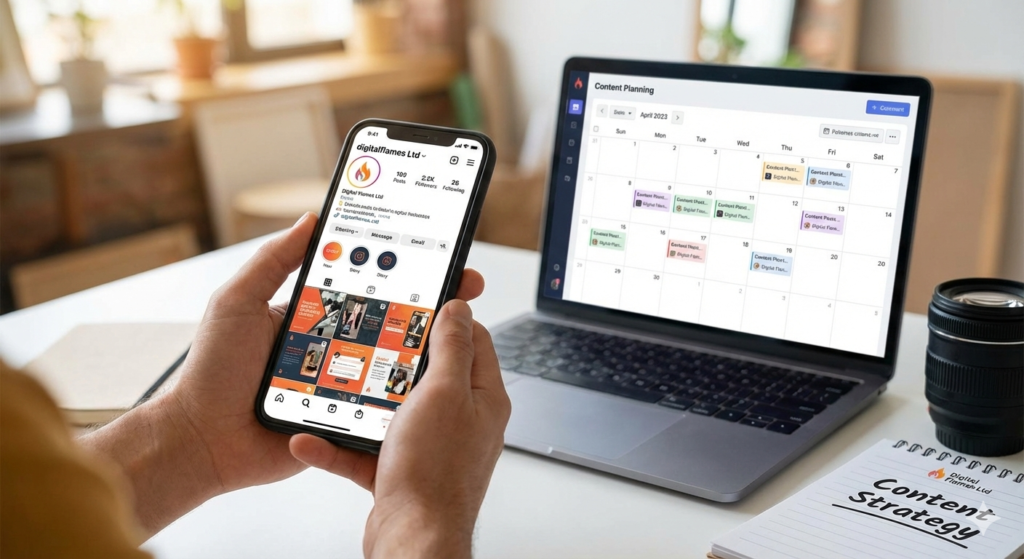
Digital Flames NG is Ibadan’s premier digital marketing agency specializing in Facebook and Instagram advertising, social media strategy, and helping businesses maximize their return on advertising spend. We work with businesses across Ibadan and Nigeria to build profitable, predictable customer acquisition systems. Visit digitalflamesltd.com to learn more about how we can help your business grow.